The Complete Beginner's Guide to Journaling — Everything You Need to Get Started
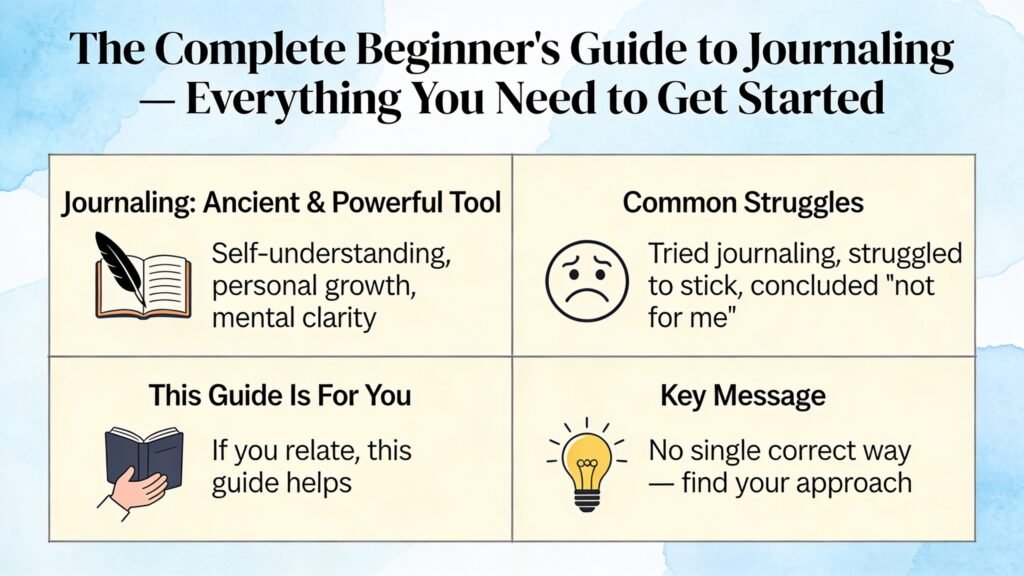
Journaling is one of the oldest and most powerful tools for self-understanding, personal growth, and mental clarity — and yet many people have tried it, struggled to make it stick, and concluded it simply is not for them. The truth is, most people just have not found the right approach yet.
In this complete beginner's guide, we will cover everything you need to know to start a journaling practice that actually works for you.
What is Journaling and Why Does It Work?
At its most basic, journaling is simply the practice of writing down your thoughts, feelings, experiences, goals, and reflections on a regular basis.
Writing by hand slows your thinking and encourages deeper reflection. When you write about a problem, you organise your thoughts in ways that thinking alone rarely achieves.
Research consistently shows benefits including reduced anxiety, improved emotional processing, enhanced self-awareness, better problem-solving ability, and even improved physical health outcomes.
Different Types of Journaling
Free Writing
Free writing means writing continuously without editing or worrying about quality. The goal is simply to get whatever is in your head onto the page.
Gratitude Journaling
Gratitude journaling involves writing down things you are grateful for each day. This practice trains your brain to notice positive experiences more often.
Goal and Planning Journals
Goal journals focus on aspirations and daily actions needed to achieve them. They often include habit tracking, planning pages, and progress reflections.
Reflective or Prompted Journaling
Prompted journaling provides questions or prompts to guide your writing, making it easier when you do not know what to write.
How to Start a Journaling Habit — Step by Step
Step 1 — Choose Your Medium
Decide whether you want a physical notebook or digital journal. Many beginners benefit from writing by hand because it promotes deeper focus.
Step 2 — Start Incredibly Small
Commit to just five minutes per day for the first two weeks. Starting small helps the habit stick.
Step 3 — Choose a Consistent Time
Morning journaling helps set intentions, while evening journaling works well for reflection and gratitude.
Step 4 — Create a Simple Ritual
Pair journaling with something enjoyable like tea or coffee so it feels relaxing rather than like a task.
Step 5 — Do Not Judge What You Write
Your journal is private. Some entries will be deep and meaningful, others short and simple — both are perfectly valid.
What to Write When You Do Not Know What to Write
Here are simple prompts to start writing:
- What is the one thing on my mind most right now?
- What went well today, and why?
- What am I finding difficult at the moment?
- What do I want tomorrow to look like?
- What am I grateful for today?
Making Journaling Stick Long Term
The best journaling practices are the ones that feel rewarding rather than like homework. If your current approach does not feel valuable, experiment with a different style or format.
Start Your Journaling Journey Today
Our Littleani 90-Day Goal Setting Journal includes daily prompts, habit trackers, weekly reflections, mood trackers, and more — all designed to help you build a consistent journaling habit.
Download instantly, print at home, and start today.
© 2026 LittleAni Journaling Guide